C4K #1
http://kidblog.org/MsToalsClass/
Callum
The students had recently done a Skype chat with a woman named Jillian. She was a marine biologist that talked to them about sharks and how they were harmless and should not be viewed as man-eaters.
C4K #2
http://kidblog.org/Grade5Days1-2/
Sahara
The students recently had to create a survey in order to better know who was viewing their blogs. I took and commented on Sahara’s “All About You” survey and also mentioned one of her earlier posts as well concerning the question: “What would you do if you were locked inside your favorite store?”
C4K #3
http://kidblog.org/MsRuizs3rdPeriod/
Levay
Levay’s class has been reading Of Mice and Men and they are in the process of posting synopses of the second chapter to their class blogs. I commented on Levay’s post and told him that I had read the book also and remembered having some of the same feelings about certain characters and that I also liked his proposed title for the chapter.
C4K #4
http://kidblog.org/MrsLongsClass-6/
Jeff
Jeff had recently posted in his blog what sacrifice meant to him. I agreed with what he said about it. I also told him that a lot of the time it is the things that we like the most that we need to sacrifice sometimes.
Thursday, February 27, 2014

Sunday, February 23, 2014
Blog Post 6
What are Personal Learning Networks? How can they help you as a teacher?
How are they formed? How can you create your own PLN? Who will be the
first additions to your PLN?
A Personal Learning Network is a method by which we can continue to learn and improve upon our own skills. A PLN is made up of both people and the various tools and other aids available. They are primarily done virtually and aid in global connectivity and allow ideas to be shared from all over the world. This is what makes a PLN great: the flexibility. Since they are primarily online, members of a PLN can respond at their convenience rather than having to get together and meet in person. They also provide an opportunity for a key element of teaching, reflection. They also encourage thinking and learning outside of the classroom. In this video, Steven Anderson describes a PLN and its importance to educators everywhere.

A Personal Learning Network can help me as a teacher because, as I mentioned earlier, they allow for reflection, which is a very important part of teaching. This reflection period allows for those within the PLN to asses and critique my work and also to give suggestions that will help me to do a better job in the future. A few ways to create my PLN include using all of the tools and resources at my disposal. Next, I would look back on my past semesters at South and at other institutions and try to remember influential professors as well as fellow students that taught me something new. I would try to get in contact with these people and see if they would mind lending their expertise when they could to help me become a better teacher. The beauty of a PLN is that I do not have to meet face to face, but rather online, so that the members of my PLN could respond at their leisure.
The first additions to my PLN would probably be the members of my group, Sparta, from this course. They are the people that I work with the most and by the end of the semester I will know them even better. I guess I already have a PLN in the works as I regularly bounce ideas off of my mother who was a teacher, as well as some of my former high school teachers for advice and inspiration. I would also have to think back to professors in my past that have really challenged me and engaged me and try to pick their brain for ways to do that myself. It's funny how at the time I could not stand certain teachers, but looking back on it, I am so much better off because of them.
A Personal Learning Network is a method by which we can continue to learn and improve upon our own skills. A PLN is made up of both people and the various tools and other aids available. They are primarily done virtually and aid in global connectivity and allow ideas to be shared from all over the world. This is what makes a PLN great: the flexibility. Since they are primarily online, members of a PLN can respond at their convenience rather than having to get together and meet in person. They also provide an opportunity for a key element of teaching, reflection. They also encourage thinking and learning outside of the classroom. In this video, Steven Anderson describes a PLN and its importance to educators everywhere.
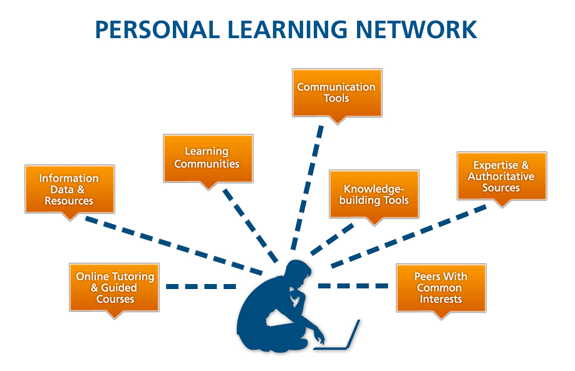
A Personal Learning Network can help me as a teacher because, as I mentioned earlier, they allow for reflection, which is a very important part of teaching. This reflection period allows for those within the PLN to asses and critique my work and also to give suggestions that will help me to do a better job in the future. A few ways to create my PLN include using all of the tools and resources at my disposal. Next, I would look back on my past semesters at South and at other institutions and try to remember influential professors as well as fellow students that taught me something new. I would try to get in contact with these people and see if they would mind lending their expertise when they could to help me become a better teacher. The beauty of a PLN is that I do not have to meet face to face, but rather online, so that the members of my PLN could respond at their leisure.
The first additions to my PLN would probably be the members of my group, Sparta, from this course. They are the people that I work with the most and by the end of the semester I will know them even better. I guess I already have a PLN in the works as I regularly bounce ideas off of my mother who was a teacher, as well as some of my former high school teachers for advice and inspiration. I would also have to think back to professors in my past that have really challenged me and engaged me and try to pick their brain for ways to do that myself. It's funny how at the time I could not stand certain teachers, but looking back on it, I am so much better off because of them.
Wednesday, February 12, 2014
Blog Post 5
What did I learn from these conversations with Anthony Capps?
These videos were all very informative and helped to better understand Project Based Learning. The first video, Project Based Learning Part 1: Experiences of a 3rd Grade Teacher, introduces Anthony Capps. He is a former student and lab professional in EDM310. He currently teaches 3rd grade at Gulf Shores Elementary School. In this video, Capps emphasizes that projects do not just demonstrate a learned ability, but also as a way to put a sense of ownership on that ability. This way of learning allows students to seek out answers, mastering sets of skills, and then demonstrating them. Capps also stressed the reflection period after sharing, which allows for peer editing and for mistakes to be corrected. During this period both the students and the teacher are learning from each other.

The second video, Project Based Learning Part 2: Experiences of a 3rd Grade Teacher, begins with the reminder that not everything is going to go well. Anthony told a story about a parent that was uncomfortable with a certain subject and he had to honor belief. He also explains that you are going to get a lot more than you expect from your students. Do not hinder their creativity with strict guidelines. “PBL is not only a means for evaluating, but also a powerful method by which students learn” (Dr. Strange). Capps also praised student choice because it led to more pride and ownership of ideas.
iCurio was introduced in the third video. It is essentially a curated search engine that allows students to safely search the web for criteria that has been filtered strictly for educational use. Students can use it as a search engine but it also has storage capacity where they can work on projects together and save their work. This allows for the development of virtual, or online, organization. This is critical for both the students and teachers.
The fourth video was dedicated to Discovery Education and it is provided to all Baldwin County teachers. It basically brings experts into the classroom through videos to help bring texts and other subjects to life. Capps stressed the importance of engaging students both through audio and video.
Video #5 was a Strange List of Tips for Teachers. It was a combined effort between Dr. Strange and Anthony to compile a few tips for teachers. A few that stood out were: to be interested in learning as well, that teaching is hard, but it can be fun and rewarding if you allow it to be, and to always allow room to share and reflect.
The sixth video encouraged educators: Don’t Teach Tech – Use It. This video encourages us to avoid putting too much time into teaching technology. Instead, we should scaffold what technology we are using to eventually allow the desired results to happen. Focus on one type of tech at a time and gradually combine various tools until a desired goal is reached. Allow time for reflection and corrections of mistakes and eventually these skills will begin to be mastered. Asking questions and problem solving are essential to Project Based Learning.
The final video was a quick introduction into a lesson and how there were for levels to each lesson. The biggest level is how it fits into the year. Big picture stuff here, like state and federal standards. Next level is how it fits into a unit. This is where the scaffolding takes place. On the next level, how it fits into a week, is where the individual steps of the scaffolding are being built. Finally, the smallest level is how that lesson fits in a day. It is just as important as all of the other levels. This is how you deliver content and material to your students. It also must be measurable in some way in order to know where to begin the next day.
Sunday, February 9, 2014
C4T #1
Comments for Teachers #1
The first blog post I commented on by Brendan Ryan was from December 15, 2013. It was a post in which he reflected back on his previous year and what he had learned as a teacher. He also looked forward to what his future might hold for him and for education as a whole. I commented by introducing myself and telling him a little about me. I then commented on something particular that he said. He talks about how he used to focus only on the tools and not the teaching. But he said that he realized “tools are fine, but good teaching and learning environments are key.” I told him that this really stood out to me because of what we were learning in EDM 310. The tools are out there and can be used by anyone, but they must be taught how to use those tools to decipher what information is reliable and trustworthy.
Brendan had not written a new blog post so I commented on his previous one. He describes how he was interested to see if other PE teachers engaged in marking and feedback, and if so, what type of material were they marking. He created a survey that he posted online for his peers to complete. While he did not get as much feedback as he expected, he did get some. I commented first by saying what a great idea the survey was and commended him for having the initiative to create it and post it.
Blog Post 4
What Do We Need to Know About Asking Questions to be an Effective Teacher?
When I first read the assignment for this blog post I thought that it was going to be difficult to answer. But after looking at the links provided and doing a little research of my own, I realized that it was not going to be that hard. After reading "The Right Way to Ask Questions in the Classroom" by Ben Johnson, I thought back to my earlier days in high school and how much I dreaded it when a teacher would ask a question. Looking back, I was one of the students that didn't really care, so I avoided any and all opportunities to respond. But at the same time, my teachers were asking questions like "Do you all understand?" To which we all nodded our heads because we were either bored or ready to go to our next class. The teacher was not truly engaging us with a question like this. However, I remember one teacher that routinely posed a question to the class as a whole and then after a few seconds, called on a student to answer it. As one of the comments to Ben's post points out, this allowed the entire class to ponder the answer without any pressure and got everyone thinking, even if it was just for a few seconds until we relaxed because she did not call our name. This teacher found a way to ask a question that would get the entire class involved and engaged, even if it was just for those few seconds until someone was called on.
Another thing that I remembered from high school was that there were some classmates of mine that were really shy and were uncomfortable answering questions out loud. In this instance, the teachers knew about this and instead of orally responding to the questions, we wrote down our answers on paper. This allowed everyone a way to express themselves fully but without drawing attention to themselves by speaking out. As I teacher, I think it will be very important to understand who I am teaching and how my students learn. That way, I can alter and modify how I teach so that my students will be getting the best possible results and learn in a way that suits them the best. I know that I will constantly be learning new things from my students while at the same time teaching them new things. We need to ask questions that will engage and stimulate our students and try to stay away from those that may distance some students from being active participants in our classroom. We need to look at these questions from both the teacher's perspective and the student's. Only then can we ask engaging questions that will help us to become more effective teachers.

Friday, January 31, 2014
Blog Post 3
How Can I Provide Meaningful Feedback to My Peers?
All three of the links provided were very helpful in better understanding the process of peer editing. While I have done some of this in the past, I never received any formal education in the process of peer editing. The first video, “What is Peer Editing,” was a Prezi that was a very helpful and simple way to explain what a peer evaluation is and a three-step way to go about them. The slideshow titled, “Peer Edit with Perfection Tutorial,” was also very helpful in that it outlined everything presented in the previous video as well as elaborate upon the three steps: Complimenting, Suggesting, and Correcting. The final link was a video named, “Writing Peer Review Top 10 Mistakes.” It is a humorous, elementary school take on the practices to avoid when peer editing. While it was performed by young children, it still contained relevant material that can be applied to my own peer editing.
The main things that I learned from these various links are: to stay positive with my comments at all times, to concentrate and pay attention when editing, to be specific as I can and avoid generalizations. Something that really stood out to me is the need to be receptive to the criticism that is given to me. It can be one of the best tools for improving my work so I need to keep an open mind when reading the critiques of my own work because one of my peers may catch something that I missed or they may have way to improve my blog post as well. The last video was pretty funny, but it brought up situations that apply to us all. All three links were very simple and easy to follow, but full of valuable information at the same time.

Sunday, January 26, 2014
Blog Post 2
What Will Teaching in the 21st Century be Like?
1. This video was illustrating how certain courses, such as a dance class, cannot be taught effectively through a lecture-only environment. There must be a practical portion of the class in which the teacher demonstrates and the students get a chance to practice. The author’s conclusion is that regardless of the amount of lecture or the experience of the teacher, without a practical setting to actually learn the technique, nothing is actually being learned. The professor seemed to bore the students instead of engage them.
2. Roberts thinks that teaching in the 21st Century means acting as a filter for all of the information that is available to students and also to teach various skills that will enable them to utilize the tools that allow them to access the information. Roberts also stresses engaging students as a way to make sure they are active participants in class. I totally agree with Roberts and his take on how teaching is changing. This is intimidating because everything I say can be fact checked, but if I use the same tools and resources I can find the right answer in the beginning.
3. After watching The Networked Student, I realized how much the teacher’s role has changed since I was a student in high school. Never in my life did I expect to use blogs, Facebook, or Twitter in my classes. But, here I am doing it for the first time. The response to the question of why the teacher was needed made perfect sense. The teacher is present to help synthesize the information gathered, to help design and usher the students along their path to mastering the skill-sets needed to sift through the endless amounts of information they will come across. I totally agree with this point of view and hope to use these tools myself in a classroom one day.
4. Vicki Davis in her own words “turned the school upside-down.” She was referring to her new style of teaching which involved using every bit of technology she could to get her students connected with the world around them. She is also constantly learning from her students and adapting and changing her style of teaching to best suit their needs. She is trying to get the best possible environment for her students by engaging them with tasks that are fun and challenging at the same time. I hope to one day be this flexible with my own students and allow them to learn in their own ways, not just the way I expect them to. She is not always the center of attention in the classroom and allows her students to do some of the teaching aided by the technology at their disposal.
 5. Flipping the Classroom is a new technique to me as well one that I could definitely see myself using in the future. It would just be a change from the everyday routine of in-class teaching or lecture and would definitely allow for more time for students to problem solve and allow their creativity to grow. They would also be able to focus on things that they did not understand and need more help with as well as those things that interest them. It would also be beneficial to the teacher because of the change of pace and the feedback that would be received from the students.
1. This video was illustrating how certain courses, such as a dance class, cannot be taught effectively through a lecture-only environment. There must be a practical portion of the class in which the teacher demonstrates and the students get a chance to practice. The author’s conclusion is that regardless of the amount of lecture or the experience of the teacher, without a practical setting to actually learn the technique, nothing is actually being learned. The professor seemed to bore the students instead of engage them.
2. Roberts thinks that teaching in the 21st Century means acting as a filter for all of the information that is available to students and also to teach various skills that will enable them to utilize the tools that allow them to access the information. Roberts also stresses engaging students as a way to make sure they are active participants in class. I totally agree with Roberts and his take on how teaching is changing. This is intimidating because everything I say can be fact checked, but if I use the same tools and resources I can find the right answer in the beginning.
3. After watching The Networked Student, I realized how much the teacher’s role has changed since I was a student in high school. Never in my life did I expect to use blogs, Facebook, or Twitter in my classes. But, here I am doing it for the first time. The response to the question of why the teacher was needed made perfect sense. The teacher is present to help synthesize the information gathered, to help design and usher the students along their path to mastering the skill-sets needed to sift through the endless amounts of information they will come across. I totally agree with this point of view and hope to use these tools myself in a classroom one day.
4. Vicki Davis in her own words “turned the school upside-down.” She was referring to her new style of teaching which involved using every bit of technology she could to get her students connected with the world around them. She is also constantly learning from her students and adapting and changing her style of teaching to best suit their needs. She is trying to get the best possible environment for her students by engaging them with tasks that are fun and challenging at the same time. I hope to one day be this flexible with my own students and allow them to learn in their own ways, not just the way I expect them to. She is not always the center of attention in the classroom and allows her students to do some of the teaching aided by the technology at their disposal.

Friday, January 17, 2014
Blog Post 1
The first time I heard anything about EDM 310 was while I was meeting with my adviser to plan out my classes at South. He didn't tell me anything scary about it but just to be prepared for the workload and not to pair it with another difficult course. I heard other things here and there in my previous education classes but nothing to deter me from taking EDM 310 this semester. Considering that I had not heard too much about the course I did not have any fears about it, but rather looked forward to the opportunity to learn some new things. The first day of class I was a little intimidated at first, but once I got the hang of it, I was comfortable.
Judging by the first two days, EDM 310 is very different from any other courses I have taken in the past. The most difficult thing for me in this class will be my time management. While not terrible, it definitely needs some work. I just need to plan out my time wisely and not allow myself to get behind at all. I will add important due dates to my calendar and stay on top of all assignments.

Judging by the first two days, EDM 310 is very different from any other courses I have taken in the past. The most difficult thing for me in this class will be my time management. While not terrible, it definitely needs some work. I just need to plan out my time wisely and not allow myself to get behind at all. I will add important due dates to my calendar and stay on top of all assignments.

Thursday, January 16, 2014
Practice Post
About Me
My name is Mitchell Lane and I was born in Columbus, Georgia where I lived for eighteen years. After graduating from high school I attended the University of Georgia in Athens where I played football for a year until I injured my hip. A year and a half later I had reconstructive hip surgery at the Mayo Clinic in Rochester, Minnesota. Once I had recovered I moved to Auburn, Alabama where I worked at a SCUBA shop and also helped teach SCUBA lessons through the Auburn University for the next four years. I soon decided to continue pursuing my education after this and applied to South Alabama. I moved to Mobile in December of 2012 and began at South the following spring. I picked South because I liked the idea of living so close to the water and because I eventually want to coach as well as teach and there is an abundance of high schools in the area. My time as a community football coach at my high school and as an assistant SCUBA instructor really opened my eyes to how much I enjoyed teaching and coaching and watching students and athletes take in the knowledge I was giving to them and to eventually be able to perform those skills on their own.
I enjoy SCUBA diving as well as spearfishing, hunting, and fishing. I love college football and basketball, as well as professional baseball, particularly the Atlanta Braves. I have been to Cozumel, Belize, and the Bahamas, to SCUBA dive. I could not survive without seafood which was another reason why I like it so much down here. I also enjoy history, which is what I plan to teach, and yet another reason why Mobile is so appealing to me because it is so rich in history.

Tuesday, January 14, 2014
My Test Post Title
This is my first post on my first blog ever. Always use the HTML button when posting in EDM 310.
Subscribe to:
Posts (Atom)